Vibe coding your startup? You're probably coding a house of cards.
I've been seeing a lot of solo founders just vibe coding their entire products. It's very impressive. You don't need a team anymore. You don't need to spend $15k/month on an agency. You can prompt your way to a working product in weeks. But there's a little problem that gets bigger over time.
AI is really good at writing code that works right now. It is still terrible at writing code that holds up over time.
If you're using AI to build your whole frontend (that's my niche, so it's all I'll speak to) and nobody senior is reviewing it, you're probably building a house of cards.
What actually happens after a few months
AI has no taste. It doesn't know what good frontend looks like. It doesn't have opinions on how components should be structured, how CSS should be organized, or whether a pattern is going to cause problems three months from now. It just answers the prompt in front of it.
That's fine at the start. But as the codebase grows, the gaps show. Files get bloated. CSS gets written in whatever way seemed to work at the time, without any real sense of layout structure. I've seen components with deeply nested positioning hacks where two lines of grid would have done the job cleanly. A non-technical person can't say it's wrong, as it looks good. It just accumulates.
And accumulation is the real problem. The bigger the codebase gets, the harder it is to manage. Fixes start breaking other parts. Token costs climb. Your AI starts contradicting its own previous decisions because the context is too tangled to reason about cleanly. Simple changes take longer than they should.
This is the wall every vibe coding founder eventually hits.
A real example
A founder recently brought me into their project. They wanted to sync search and pagination filters with the URL, a common pattern. Their AI had generated this:
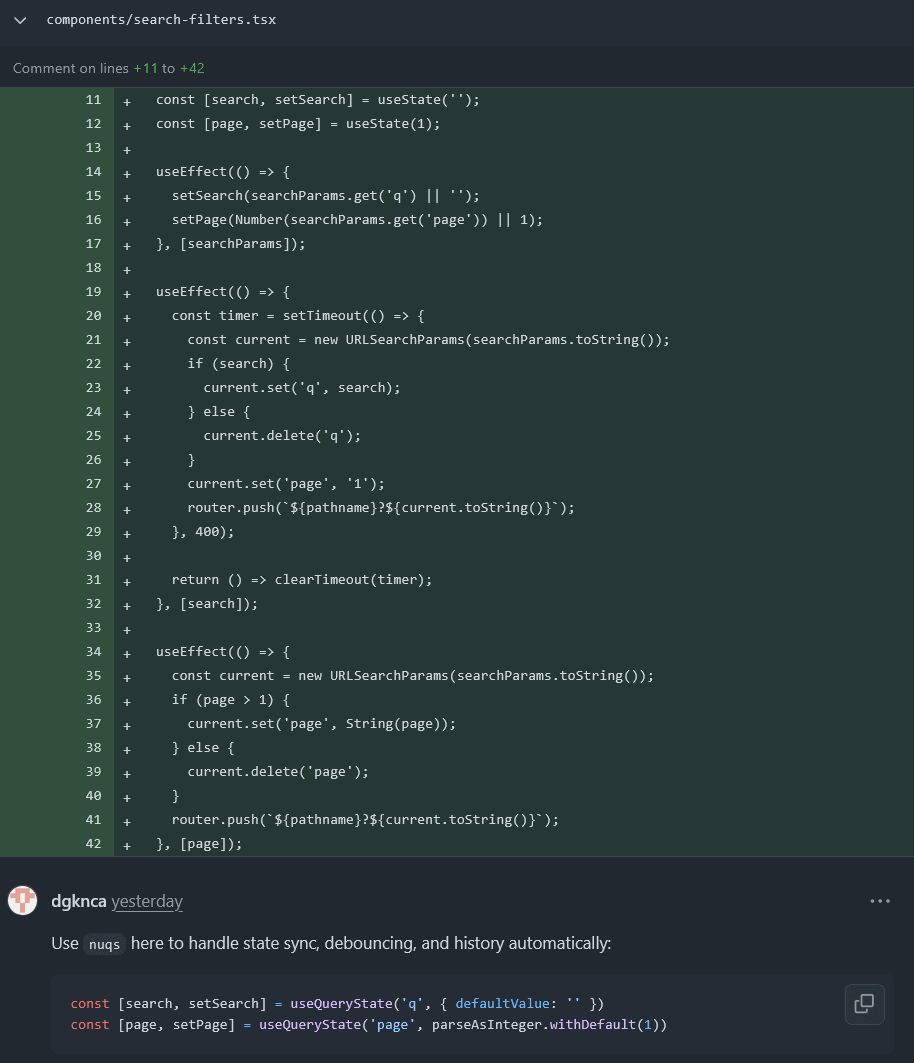
Three separate useEffect blocks, manual URL construction, no debouncing, prone to race conditions. It worked. But it was the kind of code that gets harder to touch every time you add something near it.
I left one comment suggesting nuqs, a library purpose-built for this exact pattern. They took it back to their AI agent and the whole block came down to two clean declarative lines. Same result, a fraction of the complexity.
That's the gap. Not broken code. Code that works but quietly makes everything harder.
You don't need to hire a developer
Most founders at this stage assume they need to bring on a full-time senior engineer. But if you're already doing the building yourself, a full-time hire is probably overkill.
What you actually need is someone experienced looking over your shoulder.
Think of it like having an editor. You write the draft. The editor doesn't rewrite the whole book. They catch the things you're too close to see: the structure that won't scale, the CSS that works but isn't how anyone would actually write it, the pattern that's going to bite you in three months.
That person doesn't have to be a full-time hire. It could be a senior freelancer, someone in your network, a contractor who does a monthly pass through your repo. The format doesn't matter that much. What matters is that someone with real experience is looking at your code before it becomes too expensive to untangle.
If you're building with AI and nobody senior has looked at your frontend in a while, it's probably worth finding that person sooner rather than later. The longer you wait, the more the AI has to work around its own previous decisions, and the harder it gets to course correct.
I offer this as a service for frontend at a fraction of the cost of a developer, if you're looking for somewhere to start.